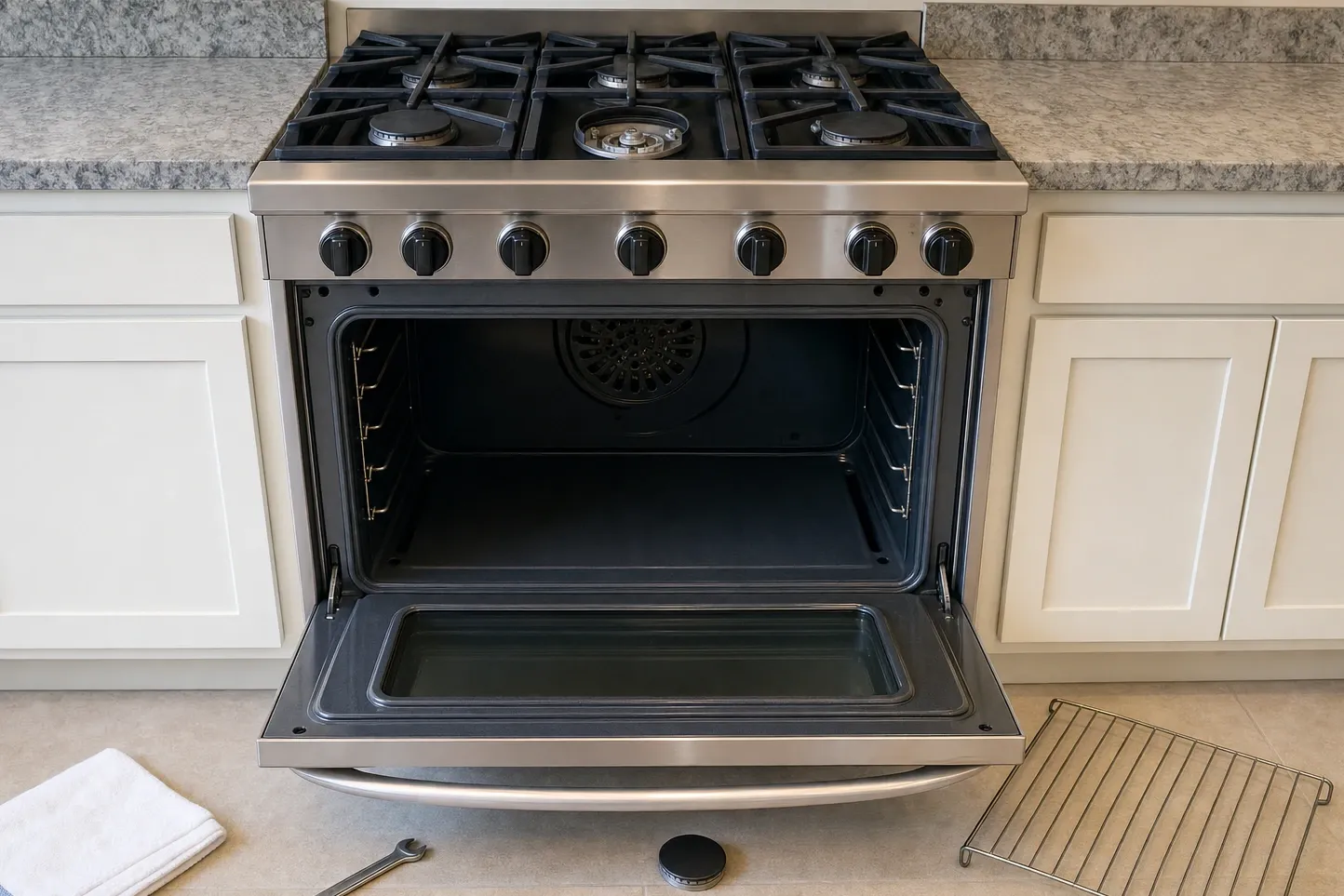
Sep · Before the cooking season
How do I clean Wolf burner caps without blocking the ports?
Lift the cap off when the burner is cold, wash it in hot water with a mild detergent, dry it completely and put it back centred and flat. What blocks ports is scouring powder, wire wool and putting a damp cap back, not cooking. If a burner still ticks after that, ring Wolf Repair Denver on (720) 575-1433 and we will look at the electrode.
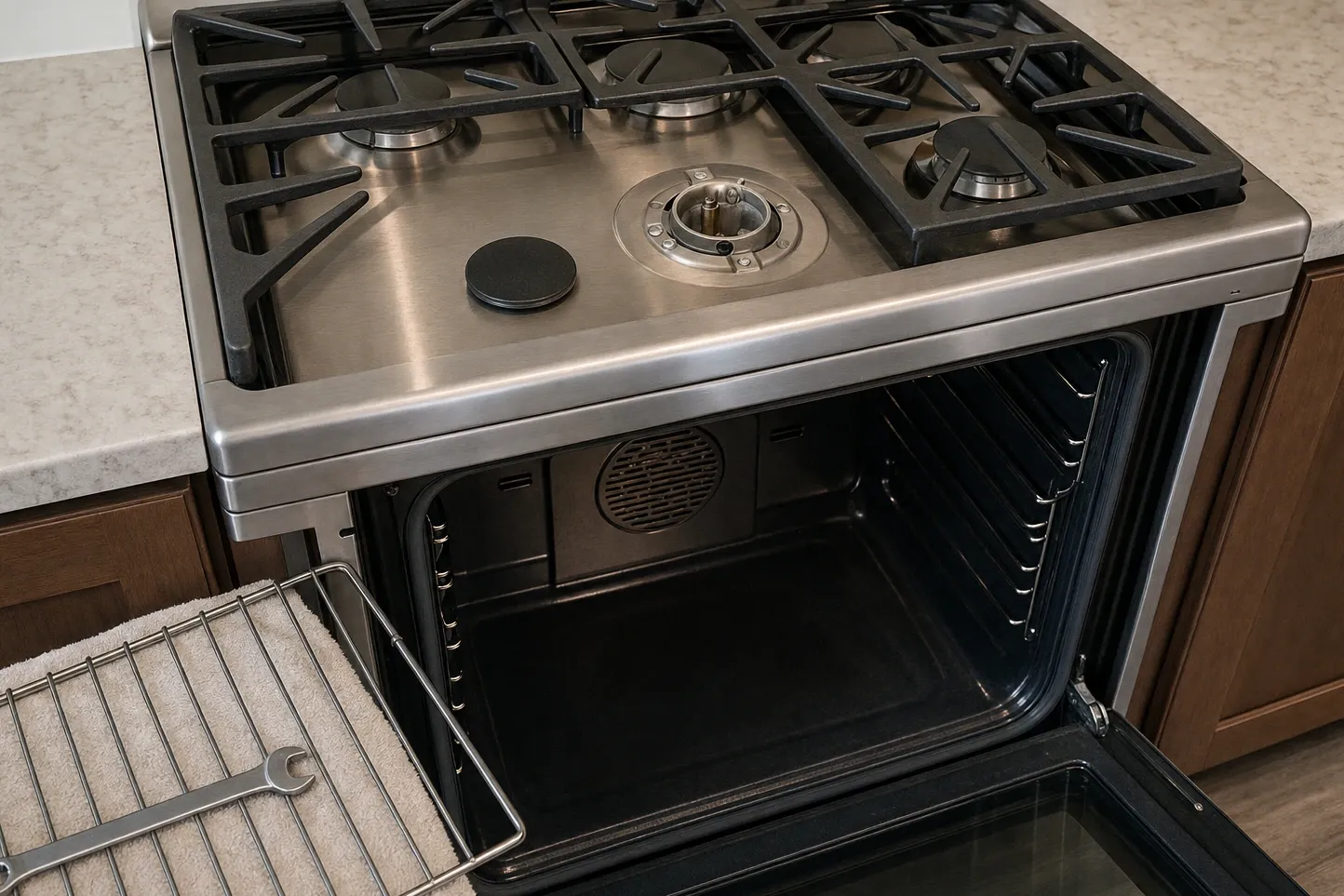
- The empty recess with the burner base still in it. Everything above this lifts off by hand.
- The cap. Turn it over before it goes back and look at the underside, not the top.
There is one thing worth understanding before you start, because it changes how careful you are being and where. The flame you cook on and the flame you simmer on come out of different places. Wolf’s burner carries two tiers of ports, and the low setting drops the flame onto the second of them. So a crust that only blocks the lower ring will leave a burner that sears beautifully and simmers unevenly, and nobody connects the two.
That is why this job is about the whole cap rather than the bit you can see. Take it off, look at the underside, and clean the ring of ports all the way round. Ten minutes at the sink, four times a year, and the burner behaves as it did on the day it went in.
How to do it
-
Wait until everything is properly cold
Wolf is direct about this: grates, caps and burner bases stay hot enough to burn long after the flame is out. Nothing here is urgent enough to do warm, and a cold cap comes off more easily anyway.
-
Lift the grate, then the cap, then the head
They come apart in that order and go back in reverse. Put each piece down somewhere you will remember, because a cap from one burner on another burner is one of the commonest reasons a clean makes the ignition worse.
-
Wash, do not scour
Hot water and a mild detergent, or a spray degreaser on the greasy ones. Wolf's care table says the same for the grates, and adds white vinegar and water for the hard-water marks that Denver leaves on a burner pan.
-
Clear the ports with something soft
A soft brush or a wooden point, working outwards. Anything metal pushed into a port enlarges it, and an enlarged port never burns the same again. If a port stays blocked, leave it and say so when you call.
-
Dry every piece completely
This is the step that gets skipped and the one that causes the ticking. Wolf's own first move for a burner that will not light is drying it, with a hair dryer on a low setting if you want to be quick about it.
-
Seat the cap flat, then test
The guide's wording is that the cap must be seated flatly on the burner. Centre it, feel it settle, then light that burner and watch: blue with a deep blue cone inside it, and no yellow anywhere.
Past that point it is a tool-and-meter job. Call Wolf Repair Denver on (720) 575-1433 and we will bring the parts that fault usually needs.
Asked about this one
Can the caps and grates go in the dishwasher?
Wolf says no for the grates: remove them, wash them by hand in hot water with detergent or a paste of baking soda, and towel them dry rather than letting them soak. Treat the caps the same way. Standing water is what starts the corrosion that eventually pits a cap.
How often is worth doing?
Whenever something boils over, and once a season otherwise. A burner that gets a wipe after every spill rarely needs anything more, and a burner that is cleaned twice a year rarely gives trouble at all. Wolf Repair Denver gets called to far more dirty burners than broken ones.
If it turns out to be a part
- Igniter or spark module
- $180–$470
A band, not a quote. The fault gets found first and the figure is agreed with you before anything is ordered.