The register
Which Wolf gas range do you have?
Open the oven door and read the plate at the bottom of the control panel, over at the far right. A code starting GR is a current all-gas body; one starting R is the series built up to 2014. Find it in the register below and the rest of this site will talk about your range instead of ranges in general — or just read it to Wolf Repair Denver on (720) 575-1433.
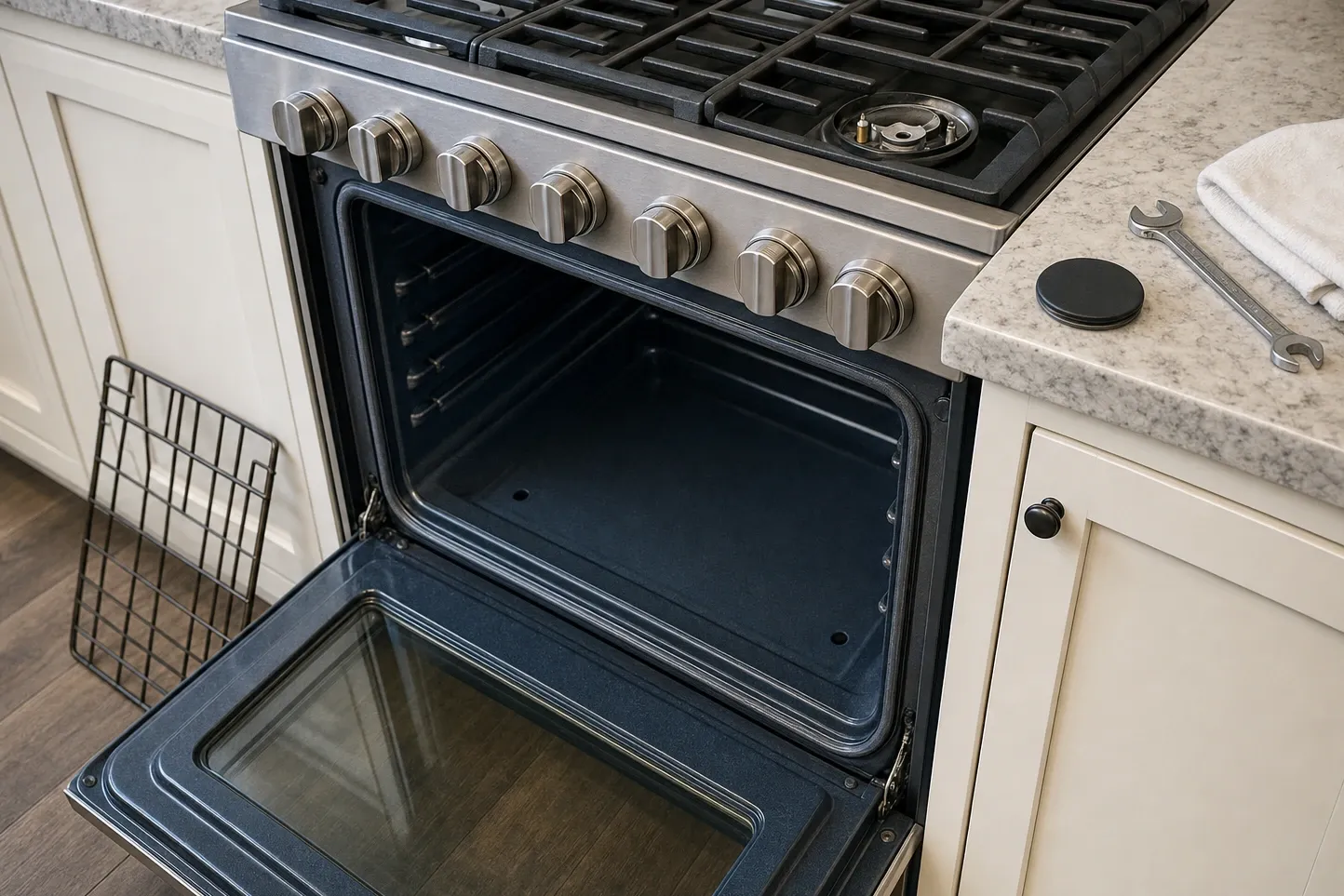
- Eight knobs across the fascia. The rating plate, not the knob count, settles which body this is.
- The opened burner, with its electrode standing clear of the base.
Before the register
Two questions that come first
- Where is the model number on a Wolf range? It is on a small metal plate low down at the right-hand end of the control panel, and the oven door has to be down before you can see it
- Does a Wolf gas range need a high-altitude kit in Denver? No. Wolf states its natural gas ranges work up to 8,600 feet with no adjustment, and Denver sits a long way under that
- Wolf GR series gas range: what goes wrong in Denver? Twelve all-gas bodies from 30 to 60 inches, all built since 2013, and a short list of faults that turns up on every one of them
- Older Wolf R series range: is it still worth fixing? Eighteen bodies built between 2002 and 2014, out of production but not out of reach, and the two things that decide whether yours is worth the work
Width by width
The GR series, as Wolf lists it
Twelve bodies, all in production since 2013. The code says the width first, then how many burners, then what is sitting between them: G for a griddle, C for a charbroiler, DG for two griddles, F for a French top.
-
Width30 inch
On the topFour sealed burners
UnderneathGas convection oven
-
Width36 inch
On the topSix sealed burners
UnderneathGas convection oven
-
Width36 inch
On the topFour burners, infrared griddle
UnderneathGas convection oven
-
Width36 inch
On the topFour burners, infrared charbroiler
UnderneathGas convection oven
-
Width48 inch
On the topSix burners, infrared griddle
UnderneathConvection oven and an 18-inch oven
-
Width48 inch
On the topSix burners, infrared charbroiler
UnderneathConvection oven and an 18-inch oven
-
Width48 inch
On the topFour burners, charbroiler, griddle
UnderneathConvection oven and an 18-inch oven
-
Width48 inch
On the topFour burners, double griddle
UnderneathConvection oven and an 18-inch oven
-
Width48 inch
On the topEight sealed burners
UnderneathConvection oven and an 18-inch oven
-
Width60 inch
On the topSix burners, charbroiler, griddle
UnderneathGas convection oven
-
Width60 inch
On the topSix burners, double griddle
UnderneathGas convection oven
-
Width60 inch
On the topSix burners, French top
UnderneathGas convection oven
The R series, out of production since 2014
Wolf’s own timeline lists eighteen R bodies built between 2002 and 2014. Their plate is somewhere else entirely — under the left-hand burner pan — and so are several of their answers.
-
Width30 and 36 inch
On the topFour or six sealed burners
UnderneathGas oven
-
Width48 inch
On the topBurners with griddle or charbroiler
UnderneathGas oven
-
Width60 inch
On the topBurners with French top or modules
UnderneathGas oven
Keeping one of these running well is a different subject, and it has twelve pages of its own.
Glossary
The words, in plain English
Everything here is taken from Wolf’s own use and care guide, its installation guide or its published answers. Where a part is not in those documents, it is not in this list either.
Finding out what you have
- Rating plate
- The metal label carrying the model and serial number. On a GR range it is at the bottom of the control panel, over at the far right, and you have to open the oven door to read it.
- Burner pan
- The shallow tray a burner sits in. It lifts out for cleaning, and on the older R ranges the serial tag is hiding on the burner box wall underneath the left-hand one.
The burner
- Dual-stacked burner
- Wolf’s sealed burner design, which the guide describes as combining all the burner parts in one assembly. It carries two tiers of ports: the upper one does the cooking, the lower one does the simmering.
- Burner cap
- The removable lid on top of the burner. The guide is blunt about it: the cap must be seated flatly on the burner. A cap a millimetre proud is behind a great many ignition complaints.
- Burner base
- The machined casting left in the recess when the cap and head come off. The orifice sits in the middle of it and the igniter electrode stands at its edge.
- Orifice
- The brass fitting with a drilled hole through it, the last thing the gas passes before it meets air. Its size is matched to the fuel the range was built for, which the rating plate states.
- Igniter electrode
- The ceramic-collared pin that throws the spark. Wolf lists the electrode, the switch and the spark module together as the parts behind a burner that clicks and will not light.
- Spark module
- The box that fires every electrode on the top. One burner clicking is usually that burner; the whole top clicking together when one knob is turned points here instead.
- Simmer setting
- A separate part of the knob’s travel, not just further down. You turn to the detent at the lowest setting, push, and keep turning; the flame drops to the second tier on the cap.
- Detent
- The deliberate stop you feel at the bottom of the knob’s travel. It is there so you have to push before the knob will go on into the simmer range.
- Btu
- The unit a burner’s output is quoted in. Wolf gives one pair of figures for the gas range family: the rear left burner at 9,200 Btu and every other burner at 15,000.
Gas and altitude
- Gas pressure regulator
- The device that holds the gas going into the manifold at a steady pressure. On these ranges it is built into the appliance, so there should be no second regulator added in the supply.
- Inches of water column
- How gas pressure is measured, written WC. Wolf’s table asks for 5 inches WC supply pressure on natural gas and at least 7 inches on the line feeding it.
- High-altitude conversion kit
- A dealer-supplied kit for installations above 8,600 feet. Wolf states that its natural gas ranges work up to that height without adjustment, and that LP ranges need no conversion at all.
- Anti-tip device
- The bracket that stops the range tipping forward when the door is loaded. Wolf requires it to be in place and engaged, and re-engaged every time the appliance is moved.
The modules on top
- Griddle
- A flat plate module in place of two burners. The guide calls it an infrared griddle, thermostatically controlled, running from 100 to 450 degrees; the double version has a control per side.
- Charbroiler
- A module with an infrared burner under a heavy grate, which the guide says transfers intense heat straight to the food. Its knob has two positions only, off and high.
- Blank-off plate
- The plate that sits centred on the ceramic tiles inside a charbroiler. Wolf asks for it to be fitted for even cooking, and it is the piece most often left in a drawer.
- Grease collection tray
- The tray a griddle drains into. The guide’s routine is to scrape into it after every use and empty it, which is also the difference between a clean module and a smoking one.
- French top
- A single solid plate heated from below, used as one large hob with hotter and cooler zones across it. Wolf built it into the 60-inch six-burner body.
- Infrared burner
- The burner type behind the charbroiler and the griddle, and behind the oven broiler. It heats a surface rather than the air, which is why it sears instead of simmering.
The oven half
- Convection fan
- The fan behind the perforated disc at the back of the cavity, switched by its own button. It is the part you can see in almost every photograph on this site.
- Oven door gasket
- The braided rope around the cavity opening. Wolf’s instruction is not to clean it: rubbing or moving the gasket can compromise the seal it is there to make.
- Rack guide
- The ladder each rack rides on. It drops into an oblong hole at the top and a bottom hole below, and a guide sitting proud of either is what makes a rack drag.
- Full-extension rack
- The rack that rolls all the way out. It hooks on by two rear tabs, one above the guide and one below, and Wolf notes it cannot go in the lowest position.
- Safety lock-out
- What the range does when a flame is lost: it shuts that burner down and flashes the indicator light. Wolf’s own fix is to turn the knob off and back on again.
- Bezel
- The ring the knob sits in, with the icon etched beside it that says which knob belongs there. Knobs and bezels are wiped with a damp cloth and never go in the dishwasher.
Book it
Read us the code and we will tell you what usually goes
Say what the flame is doing and the van is loaded for that fault before it leaves. $89 pays for the drive and for finding it, and comes off the bill when you say go ahead.
Out on calls 8:00 am – 8:00 pm, seven days · the number is live 24/7