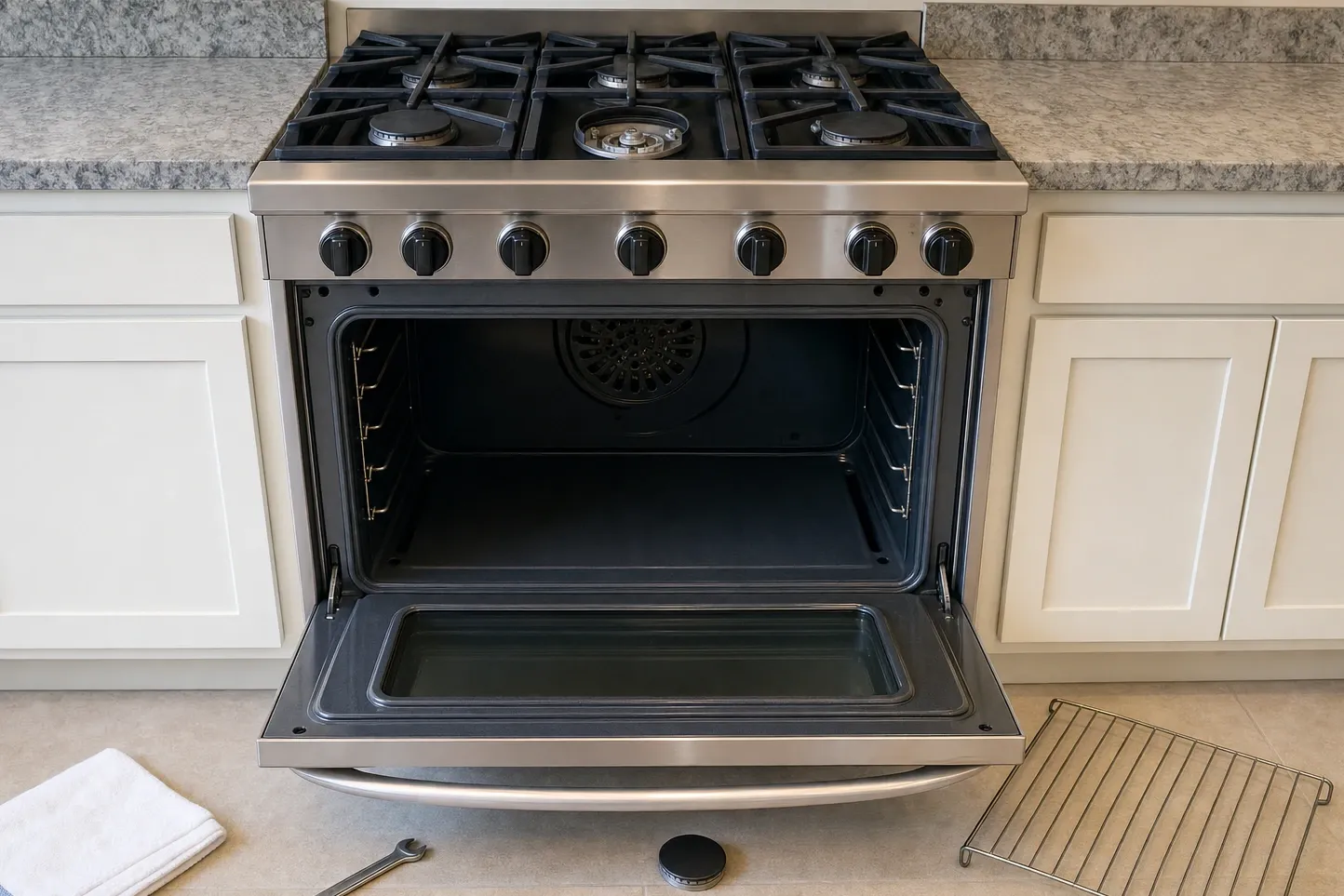
Jan · Heating on, windows shut
What should a Wolf flame look like at 5,280 feet?
Exactly as it would at sea level: blue, with a darker cone standing inside the blue, and no yellow at the tips. Wolf builds these ranges to run at this height with nothing altered, so a flame that looks wrong in Denver is wrong for an everyday reason. Walk the top once a year, and ring Wolf Repair Denver on (720) 575-1433 about any burner that fails the look.

There is a reason this page belongs on a Denver site rather than a general one. Altitude is the first thing blamed here when a burner looks wrong, and a high-altitude kit is the first thing asked for. Neither is usually the answer — so a year can go by with a burner quietly burning badly while everyone puts it down to the elevation.
What genuinely changes a flame is smaller and nearer to hand: a film of grease across the ports, a cap sitting proud on one side, a humidifier loading the indoor air with damp, a pan wide enough to smother the burner underneath it. Every one of those is visible in the ten minutes this check takes, which is the argument for doing it deliberately once rather than noticing it in the middle of cooking.
How to do it
-
Wait for a dull hour and drop the kitchen lights
Flame colour is hard to judge in a bright room and impossible in sunlight. Early evening, with the hood light off, shows you what is actually burning. A whole top takes about ten minutes.
-
Run every burner on high, then down to simmer
Work along the row rather than jumping about. On high you are reading colour and shape; at the simmer setting, past the detent, the flame drops onto the second tier of the cap and should sit there quietly.
-
Read the colour before the size
Blue through the body with a deeper blue cone inside it is right. Yellow tips, a flame that will not stay down on its ports, and one burner roaring where its neighbours hiss are the three things to note. A propane burner shows some orange tipping, and that is how it should look.
-
Rule out the ordinary causes first
Wolf's list runs through a dirty burner after a spill, parts put back out of position, pan size, the wrong supply gas, pressure that is too high or too low, a tired regulator, and indoor damp — which in a Denver winter usually means the humidifier.
-
Write down what you saw, burner by burner
A line of notes beats a photograph, because a flame never photographs as the eye sees it. It also lets us arrive with the likely part rather than find the same fault twice.
Past that point it is a tool-and-meter job. Call Wolf Repair Denver on (720) 575-1433 and we will bring the parts that fault usually needs.
Asked about this one
Does the thin air up here change what a good flame looks like?
No. Wolf sets the height at which one of its gas ranges needs altitude work at 8,600 feet, and the city sits a long way beneath that line. The picture you are checking against here is the one an owner anywhere uses, and a flame that fails it has an ordinary cause.
How often is this really worth doing?
Once a year covers it, and midwinter suits it best: the house is shut up, the humidifier is running and the burners are working hardest. Ten minutes does a whole top. If something looks off and a proper clean does not settle it, that is the moment to call Wolf Repair Denver.