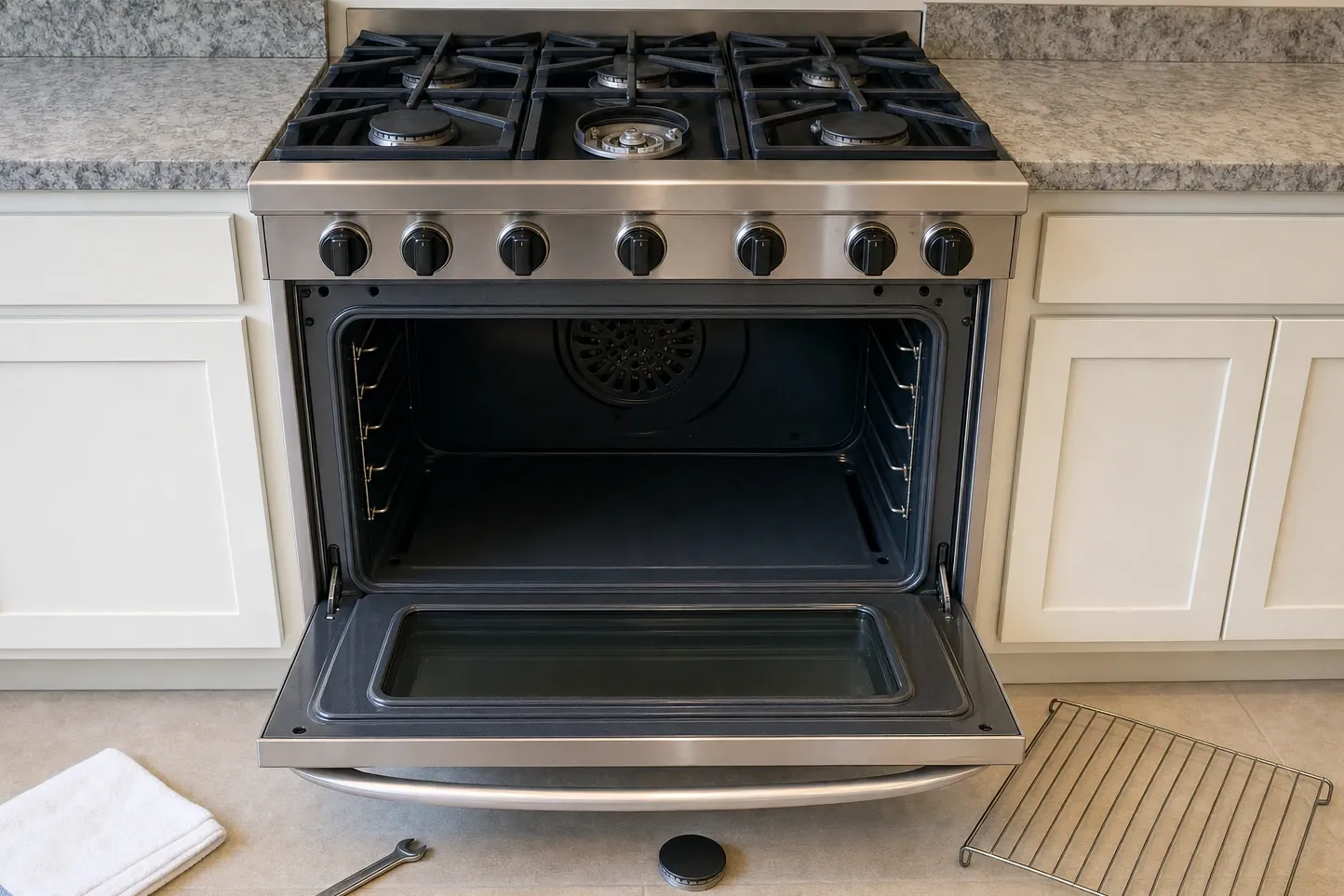
Range Repair
Why a Wolf range will not simmer in Denver, and what actually fixes it
A low flame that still scorches is almost never a conversion problem: Wolf builds these ranges to run unadjusted to 8,600 feet. What thin air really does, the four faults behind a runaway simmer, and what to check before calling anyone.
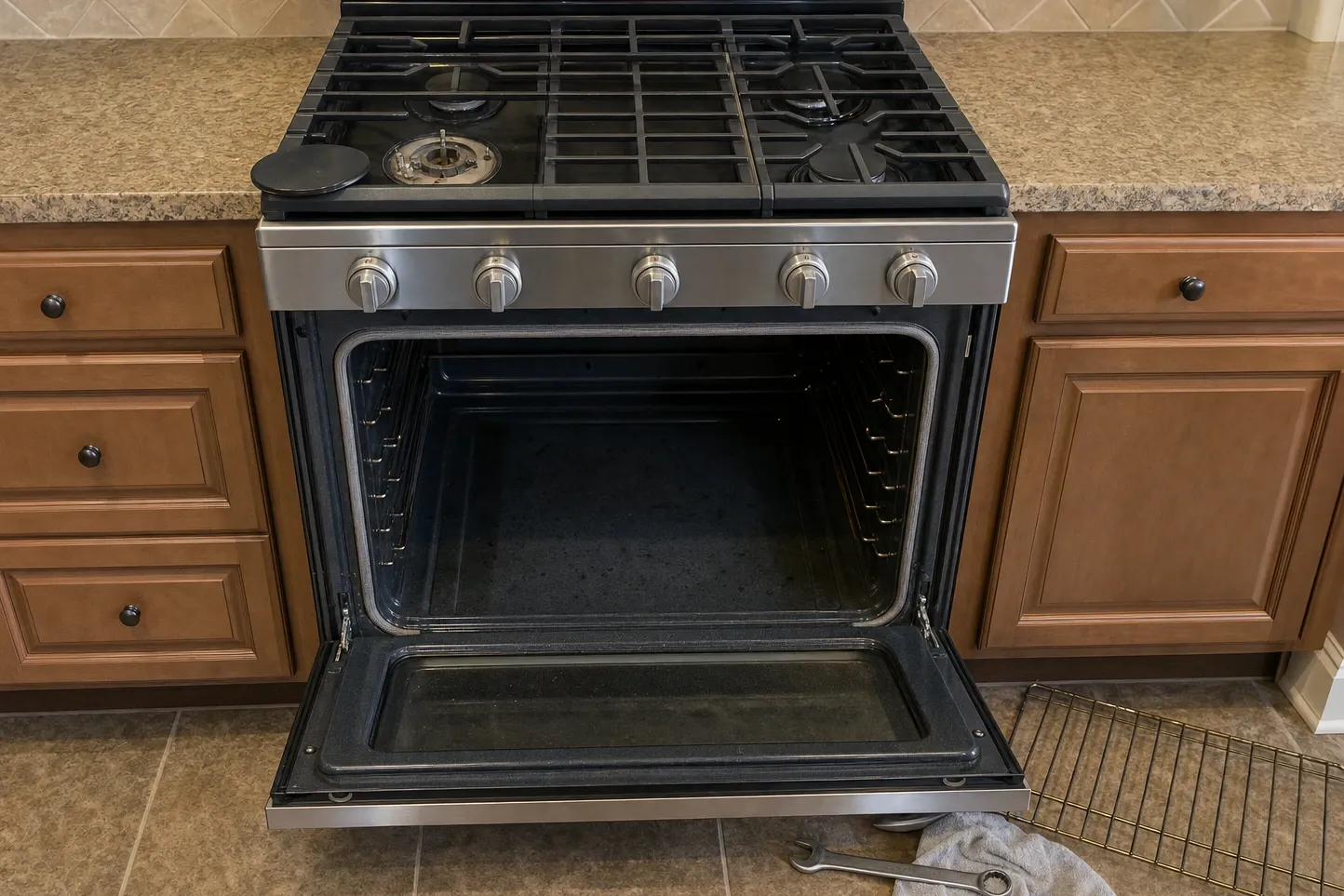
There is a specific complaint that arrives from Denver kitchens more than anywhere else, and it is almost always described the same way: the range is beautiful, the sear is superb, and it cannot hold a simmer to save its life. Chocolate splits. A béchamel catches in ninety seconds. The lowest notch on the dial still produces a rolling boil in a heavy pan, and the owner has usually spent a year assuming they are doing something wrong.
They are not, and in most cases neither is the range. But the reason is almost never the one the internet gives them. Wolf states plainly that its natural gas ranges work up to 8,600 feet with no adjustment, and Denver is a long way under that: this is not a range that arrived wrongly set up.
What thin air does to a low flame
A gas burner is a fixed-volume device. The orifice — a brass jet with a drilled hole a fraction of a millimetre across — passes a set volume of gas at a set pressure, and the burner head mixes that gas with whatever air it can pull in around it. A cubic foot of Denver air, drawn in at 5,280 feet, carries roughly a sixth less oxygen than the same cubic foot at sea level.
That shifts the mixture, and it is why the manufacturer bothers to publish a ceiling at all. What the ceiling tells you is that the shift stays inside what the burner is built to absorb until you are a good deal higher than this city. So the thin air is real, but on its own it is not enough to ruin a simmer: it is a handicap a burner in good order carries without complaining, and one a burner in poor order cannot.
It also explains the shape of the complaint. The sear is fine and the boil is fine, because at full output a burner has capacity to spare. Everything marginal shows up at the bottom of the travel, where the flame is meant to be a thin, steady ring and there is no spare capacity left to hide behind.
The four things it usually turns out to be
In order of how often we find them:
- The simmer range never being entered. Far and away the most common, and the one nobody expects. Wolf puts simmer past a detent: down to the stop, push the knob in, then keep turning, and the flame moves onto the second tier of ports in the cap. A knob that is only ever turned, never pressed, never gets there at all.
- Supply pressure that is not what the range expects. Wolf asks for five inches of water column going into the appliance, with at least seven on the line feeding it, and the regulator that holds it is built into the range. A house running a furnace, a water heater and a wide range off one undersized run does not always deliver that.
- A second regulator added in the supply. One of the first things Wolf asks about a burner burning badly, because the range already carries its own and another one upstream fights it. That is an installation question rather than a fault, and it is settled by looking.
- A burner head not seated, or ports partly blocked. Grease and boil-over crust the ports nearest the electrode first. A partly blocked crown makes the flame uneven and lazy in exactly the way a rich mixture does, so it gets misdiagnosed as an altitude problem when it is really a cleaning problem.
The first and the last of those are yours to settle this evening. The middle two need a gauge and a look behind the range, which is worth saying plainly rather than pretending otherwise.
What you can check in ten minutes
Take the grate off and lift the burner cap. Look at the crown: the small drilled ports should be open and evenly spaced, with no crust ringing them. A soft brush and a wooden point clear them; never put anything metal into a port, because widening it changes that flame for good.
Check the cap is properly seated. Wolf caps drop onto a machined seat and it is easy to leave one a millimetre proud after cleaning, which lets gas escape sideways and makes the flame lean.
Now light the burner and look at the flame with the kitchen lights down. Wolf describes a healthy one on natural gas as blue with a deep blue cone inside it and no trace of yellow; on propane a little orange tipping is normal. Then take it down to the stop, press the knob in, and keep turning. Watch for thirty seconds: a correct low flame is small, even and continuous all the way round the cap.
Finally, check the obvious mechanical things before assuming physics. The flexible connector behind the range should not be kinked, and the shutoff valve at the wall should be fully open — we have found a half-closed wall valve behind a bungalow range more than once, and the symptom looked exactly like a starved burner.
What we do on the call
Every burner gets lit and looked at first, because a flame tells you more in ten seconds than a meter does in ten minutes. Then the supply is measured at the appliance and set against what Wolf asks for, and the caps come off so the ports, the seats and the electrodes can be seen rather than guessed at.
After that it is mechanical: caps seated flat, ports clear, knobs springing back, and every burner walked through its whole travel with a pan on it, simmer range included. The last step is the one that matters to you — a real simmer, held for several minutes, watched rather than assumed.
If a burner still will not behave after all that, the fault is mechanical — a worn valve stem, a cracked electrode leaking spark into the burner body, or a damaged crown — and that gets quoted as a part with the price agreed before it is ordered.
When it is worth calling
If the range has never simmered properly since the day it went in, and pressing the knob past the detent changes nothing, call. That pattern points at the supply or at the installation rather than at the range, it is a single visit, and it is worth settling once.
If the simmer used to be fine and has drifted, start with cleaning: crusted ports and a poorly seated cap account for a good share of those, and you can fix both with a brush this evening.
If you smell gas at any point, or a burner is lighting with a bang loud enough to hear from another room, do not work through a checklist. Shut the wall valve, ventilate the room, and call. Delayed ignition is gas collecting before the spark reaches it, and it is the one symptom on this page that is not worth living with for another week.
Follow-up questions
Does a Wolf range need converting for Denver altitude?
No. Wolf’s installation guide states that its natural gas ranges function up to 8,600 feet without adjustment, and that LP ranges need no conversion at all. Denver sits around 5,280 feet, well under that line. A kit exists for installations above it, from a Wolf dealer, and nothing in this city qualifies.
Can I fix a hot simmer by turning the burner down further?
Not by turning harder, but there is further to go than most people realise. Wolf’s simmer range sits past a detent: you turn to the stop at the bottom, push the knob in, and keep turning, and the flame drops onto the second tier of ports in the cap. A great many hot simmers are that step never being taken.
Is a yellow flame dangerous or just inefficient?
Both, in different amounts. Yellow tips mean incomplete combustion, which means carbon monoxide and soot. On a well-ventilated cooktop it is mostly a nuisance and a dirty pan problem, but a burner that has gone yellow across the whole crown, or one that yellows in a closed kitchen, should be looked at rather than lived with.