Range Repair
Wolf Oven Maintenance: What to Clean and What to Leave Alone
Wolf oven maintenance comes down to wiping spills while they are fresh, keeping foil off the oven floor, leaving the door gasket untouched and prepping the cavity before any Clean cycle. Here is the full routine, plus the signs that it is time to call.
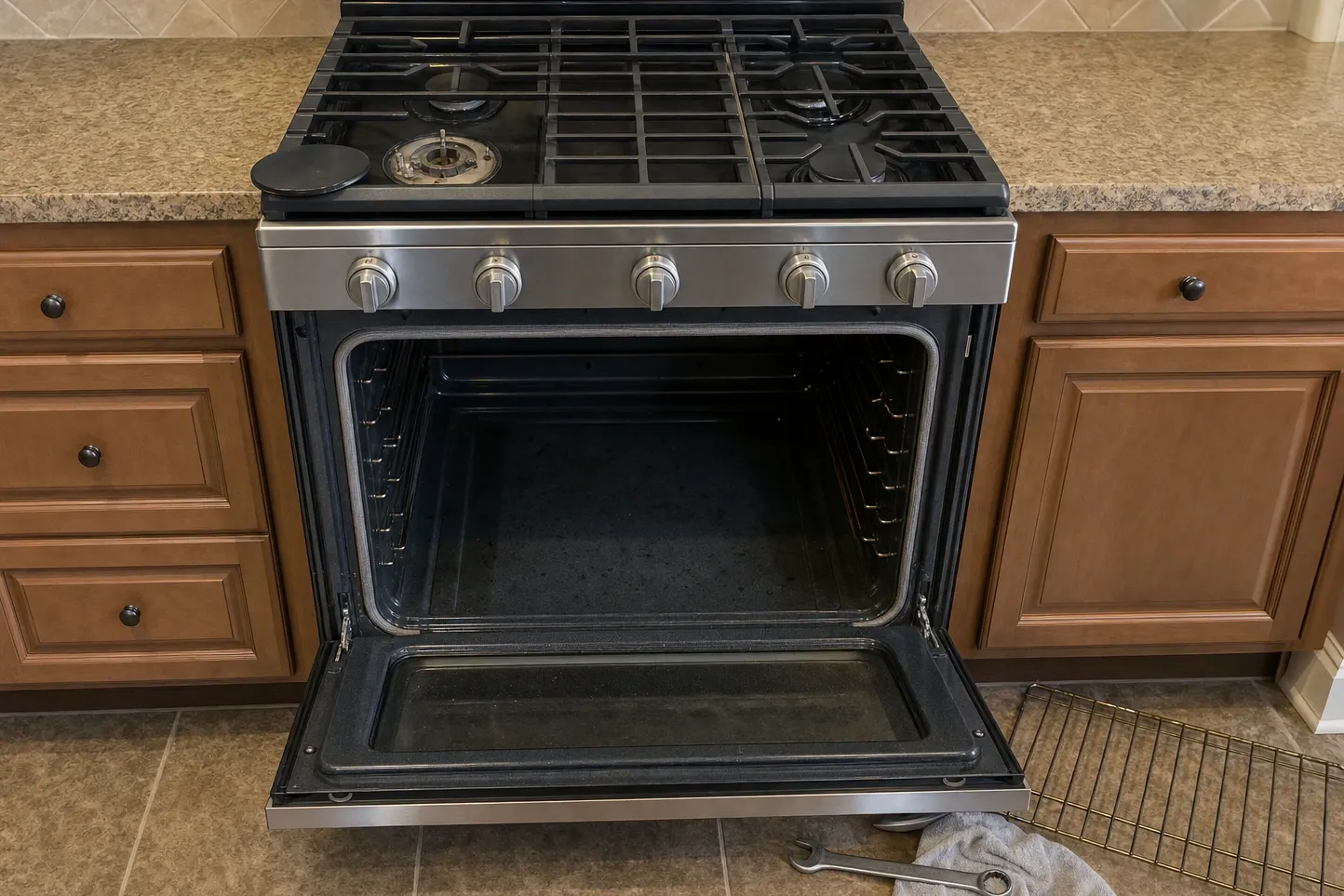
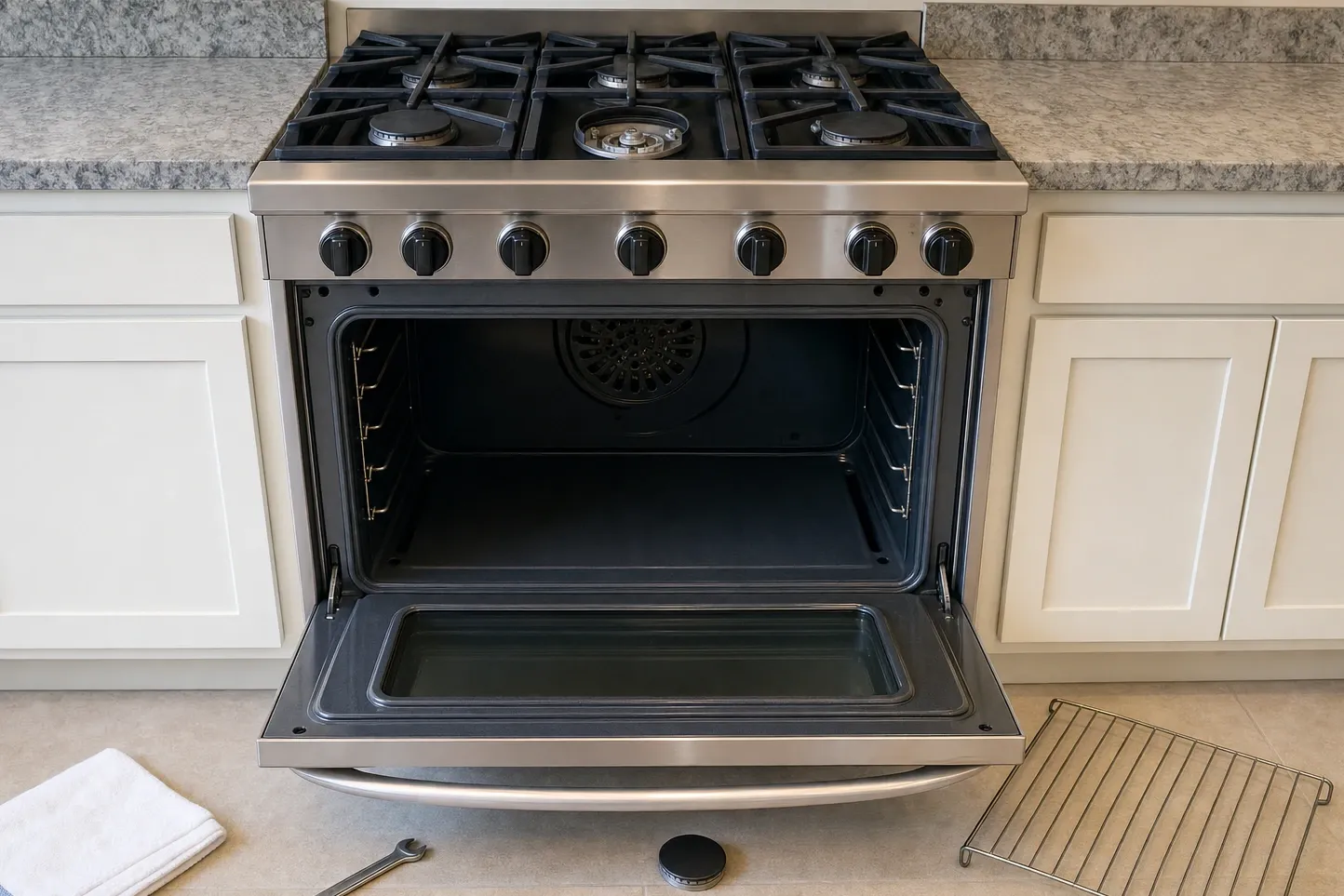
Wolf oven maintenance is mostly a handful of small habits: wipe sugary or tomato spills once the oven is safe to touch, keep foil and pans off the oven floor, leave the door gasket alone, and scrape and wash the cavity before you ever run a Clean cycle. Add a regular look at the burners, caps and igniters on the rangetop, and most parts of a Wolf wear out gradually instead of quitting halfway through a dinner party. In Denver there is one more reason to keep things clean: burners here work in the thinner air a mile above sea level, so you want to be sure an odd-looking flame is a setup question and not simply a dirty port.
Start a new oven the right way
If the range is new, or the oven has just been replaced, Wolf asks for a burn-in before the first meal. Wash the cavity, then run Bake at 500°F (260°C) for 30 minutes and follow it with Broil for another 30 minutes, keeping the hood on throughout. Let the oven cool with the door closed. Wolf wall ovens get a similar start: a wash with hot water and mild detergent, then Convection Roast at 500°F (260°C) for one hour with the ventilation running. Some smoke and smell during that first run is normal and fades afterward.
Everyday care inside the cavity
Sugar, citrus, wine and tomato sauce should come off as soon as the oven has cooled enough to wipe safely, because Wolf notes that some blemishes from those spills never come out. They will not change how the oven bakes, but they stay.
Keep pots and pans off the oven floor, and never line the floor or side walls with aluminum foil. Wolf says either habit damages the porcelain and voids the warranty. On a gas oven there is a safety reason too: the Consumer Product Safety Commission warns that foil across the bottom blocks the combustion air flowing through the appliance and can lead to carbon monoxide. If you want something to catch drips, slide a sheet pan onto the lowest rack.
Racks that grind or stick are usually a glide issue rather than a dirt issue, and our page on why oven racks drag explains what actually helps.
Leave the door gasket alone
This one surprises most owners: Wolf tells you not to clean the oven door gasket at all. Rubbing it, or even shifting it slightly, can break the seal that holds heat in. Inspect it by eye instead. Look for flattened stretches, frayed spots, a gap where light shows with the door shut, or brown heat marks on the trim around the door. Any of those means heat is escaping, and how to tell the gasket is finished goes through the signs one by one.
If the door will not close fully, rule out the simple causes before anything else: a rack sitting past its stop, a pan handle catching the frame, or a gasket that has crept out of its channel. A door that still springs open, sags at one corner or closes unevenly usually points to worn hinges.
Before and after a Clean cycle
If your Wolf oven has a Clean cycle, the preparation decides how well it works. Lift thick, baked-on spots with a razor blade, then wash the cavity with soap and water. That wash matters more than it sounds, because leftover residue from spray oven cleaners can etch the porcelain once the cycle heats it. When the cycle ends and the oven has cooled, wipe out the loose ash with a damp cloth.
Expect some wear from high heat over the years. Wolf explains that expansion and contraction, especially during self-clean, can leave fine hairlines, small chips or a cloudy patch in the enamel, and a colored interior shows it more. It is cosmetic only. Many owners skip self-clean in the days before hosting, leaving time to fix anything it reveals.
The rangetop: burners, caps, grates and igniters
Wash the grates whenever grease builds up and dry them completely before they go back. Each burner cap should sit flat and centered on its head; a tilted cap gives a ragged flame and can keep the igniter clicking. Clear the ports gently, since the wrong tool can widen or plug them, and our guide to cleaning burner caps without blocking the ports shows a safe method.
Clicking right after a boil-over is often just moisture and stops once things dry out. Clicking that never stops on a dry burner, or a flame that lifts off the ports, burns yellow or roars, deserves a closer look, and in Denver part of that check is whether the range was ever given its high-altitude setup. Above the cooktop, soak the hood’s baffle filters in hot soapy water when they feel tacky; a greasy baffle captures less smoke and drips more.
Steam and speed ovens follow their own rules
A Wolf convection steam oven needs minerals in its water, so fill the tank with fresh cold tap water, never distilled, filtered or demineralized. A full tank gives about four hours of steam on a 24-inch model and two hours on a 30-inch one. For routine cleaning, run Clean mode at 176°F (80°C) for 30 minutes and wipe the interior; racks and stainless pans can go in the dishwasher, but the water tank cannot. When the display reads Boiler Scaled Up, Please Descale!, it is time, which may be every 6-18 months depending on how hard your water is. Use only Wolf’s descaling solution, part number 820021, emptying the whole bottle each time. Descale takes about 45 minutes with 16.9 oz (500 mL) and cannot be cancelled once it starts. Skip vinegar: Wolf says it descales poorly, can harm the oven and offers none of the corrosion protection.
On a speed oven, the racks, risers and turntable are dishwasher safe, chemical oven cleaners stay out, and the waveguide cover at the top of the cavity gets wiped but never removed.
| Task | When |
|---|---|
| Wipe sugary, acidic or tomato spills | As soon as the oven is safe to touch |
| Wash grates and reseat burner caps | Whenever grease builds up |
| Clean hood baffle filters | When they feel tacky |
| Inspect the door gasket, eyes only | A few times a year |
| Scrape and wash the cavity | Before every Clean cycle |
| Descale a steam oven | When the display asks |
When maintenance is not the answer
A gas oven that stays cold or crawls up to temperature usually has a weak igniter, and a temperature that wanders from the setting points to the sensor. A power reset at the breaker is worth one try first. Typical ranges in Denver homes from LoDo to Berkeley: igniter or spark module $180–$470, thermostat or sensor calibration $220–$470, door hinge, glass or seal $280–$720, and control board or touch panel $460–$850. The firm quote comes after diagnosis. The visit itself is a flat $89 for the trip and the diagnosis, credited in full against the repair once you approve it. Call (720) 575-1433 to arrange it.
Follow-up questions
How do I reset a Wolf oven?
Cutting the power is the usual reset: switch off the oven's breaker, wait a minute or so, then turn it back on and let the controls start up again. If the same fault, a blank display or a cold oven returns straight away, the reset has not touched the cause, and a technician should test the controls and sensors before you keep cycling the power.
What tells me a Wolf oven has finished preheating?
The oven signals it, with a tone, an indicator light or a change on the display depending on the model, and your use and care guide shows which cue yours gives. For a heavy roast or a baking stone, give it a few extra minutes after the signal, since the racks and stone are still soaking up heat.
Why won't my Wolf oven door close all the way?
Usually a rack is pushed past its stop, something is caught at the frame or the gasket has slipped out of its channel. Check those first. If the door still springs open or hangs crooked, the hinges or the seal need work, which typically runs $280–$720 for door hinge, glass or seal repairs, with the firm price given after diagnosis.
Why is my Wolf gas oven not heating up?
A tired oven igniter is the most likely reason, because on many gas ovens the valve will not release gas until the igniter is hot enough. A drifting temperature sensor causes similar complaints. Igniter or spark module work typically runs $180–$470 and sensor calibration $220–$470, confirmed once the $89 diagnostic visit has found the fault.
Can I put foil on the bottom of my Wolf oven?
No. Wolf says foil on the oven floor or side walls damages the porcelain and voids the warranty, and on a gas oven the CPSC adds that foil there can starve the burner of combustion air and produce carbon monoxide. Catch drips with a sheet pan on a low rack instead.