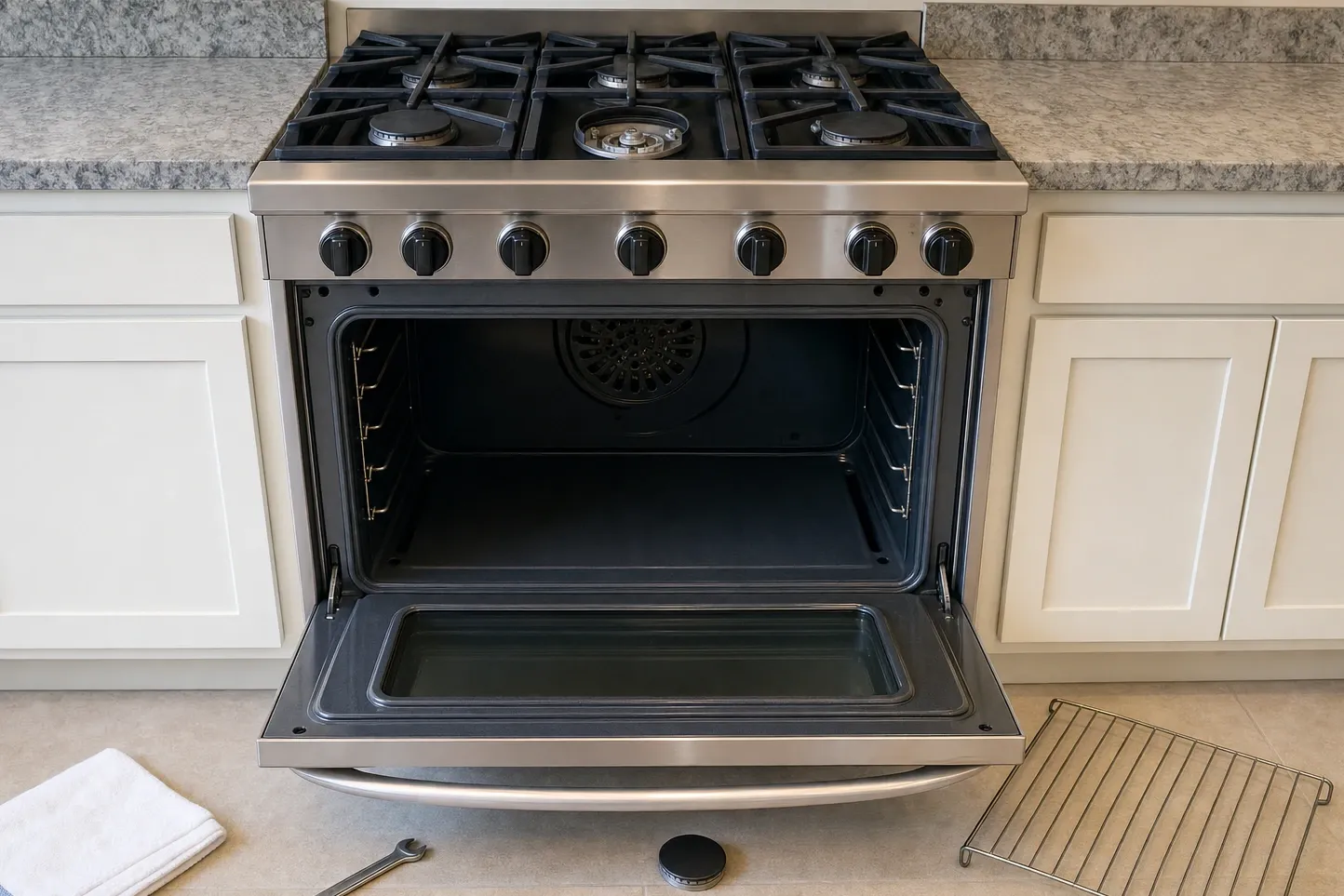
Current production, from 2013
GR486G
- Width
- 48 inch
- On the top
- Six burners, infrared griddle
- Underneath
- Convection oven and an 18-inch oven
Wolf GR486G: six burners, one griddle, what breaks?
A GR486G is forty-eight inches carrying six sealed burners, an infrared griddle and two separate oven cavities, so the useful first question is which of those three the trouble is actually in. Tell Wolf Repair Denver on (720) 575-1433 whether it is the top, the big oven or the little one, and the diagnosis starts in the right place.

Denver has a great many of these. When a builder specified a professional range for a new house at Central Park or Lowry, forty-eight inches with six burners and a griddle was the order that went in, and most of those ranges are still sitting in those kitchens doing the same work fifteen years later.
The word that causes the trouble on this body is oven. There are two behind that fascia, each with its own knob, its own burner and its own thermostat, and Wolf’s control chart treats them as separate appliances: the main cavity runs to 500 degrees and broils, the eighteen-inch one runs the same span of temperatures with no broil against its name. A household that has only ever used the big one often discovers the small one has quietly given up, and discovers it on the day two trays need to go in at once.
Worth knowing about the space it sits in, too. The forty-eight inch model was drawn for a straight forty-eight inches of opening, and where no hood hangs over the range Wolf asks for forty-two inches from the countertop up to anything combustible. Its note singles out charbroiler bodies and the GR488 as the two that want non-combustible materials around them; a griddle body is not on that list.
What it usually turns out to be
Every figure below is a band, not a quote. The fault is found first, the number is agreed with you second, and nothing is ordered until you have said yes to it.
-
The griddle takes an age to reach the number on the knob
UsuallyThat plate is heated by one infrared burner and held by a thermostat, so the light above the knob stays lit until it arrives and then cycles. Slow from cold is the design. A light that never settles is not.
What it costs Nothing — the range is behaving as built
-
The light above the griddle knob has started flashing
UsuallyWolf's own answer is that the module lost its flame and dropped into safety lock-out. Turning that knob off and then back on clears it. Twice in one week, though, is the range telling you something real.
What it costs Nothing, once that check is done
-
The small oven will not light after a year of standing idle
UsuallyThe eighteen-inch cavity is a gas oven in its own right, with its own knob and its own ignition, and long spells unused are hard on all of them. It gets checked at the spark first and the flame second.
Quoted from Igniter or spark module $180–$470
-
The big oven bakes cool while the small one seems right
UsuallyTwo cavities, two controls, two sets of readings, and no owner calibration published for either. The one that is drifting is measured across a full preheat against a reference before any part is named.
Quoted from Oven thermostat or sensor calibration $220–$470
Still wondering
Is the eighteen-inch oven any use, or is it a gimmick?
It is a proper oven in a smaller box. Wolf's control chart gives it 150 to 500 degrees, the same span as the main cavity, with broil left off its list. For one tray it brings a much smaller space up to heat, which is the entire point of it.
Why does the griddle stop at 450 degrees?
Because it is thermostatically controlled rather than simply lit or out. The knob is marked from 100 upwards and the burner beneath cycles to hold whatever you have asked for, which is what lets one surface do pancakes in the morning and a steak in the evening.
Does it matter which oven I mention when I call?
It matters more than anything else you can tell us. The two cavities fail independently and take different parts, so naming the one that is misbehaving lets Wolf Repair Denver load the van accordingly. Open both doors, see which knob you were reaching for, and say so.